School leaders are constantly balancing multiple initiatives, competing priorities, and limited resources. The challenge is not just deciding what to change, but also when and how to implement it to maximize impact. Just as the Eisenhower Matrix helps leaders prioritize tasks based on urgency and importance, a structured approach to the change process can help principals strategically manage initiatives, align staff readiness, and ensure sustainable improvements.
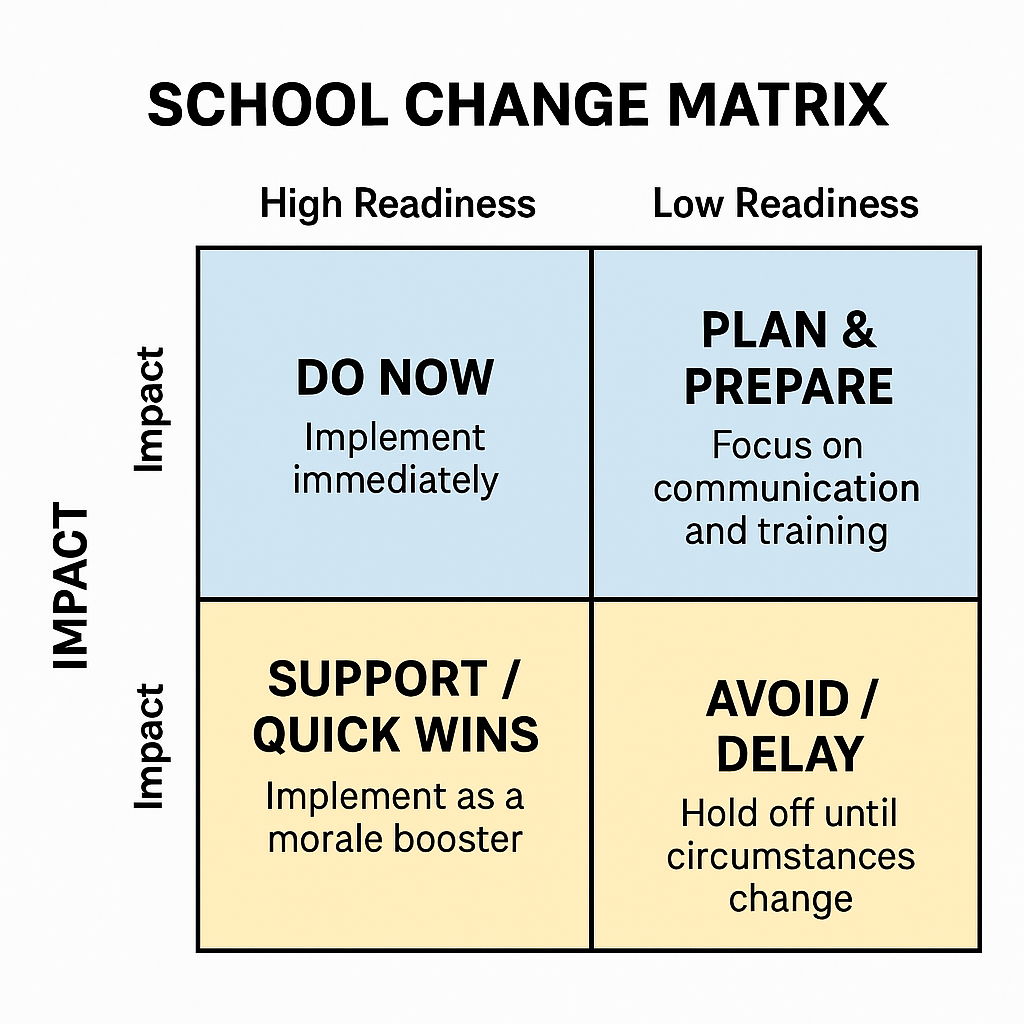
Not all changes are equal—some have high impact but low readiness, while others may be easy to implement but produce only modest results. Using a visual framework allows school leaders to prioritize initiatives, build momentum, and allocate resources wisely. The matrix below provides a practical tool for evaluating potential changes along two dimensions: impact on student learning and school effectiveness and readiness of staff and community.
School Change Matrix (Eisenhower-Style)
| High Readiness | Low Readiness | |
|---|---|---|
| High Impact | Do Now | Plan & Prepare |
| Low Impact | Support / Quick Wins | Avoid / Delay |
Quadrant Descriptions:
- Do Now (High Impact / High Readiness):
- Initiatives that are both ready to implement and will have significant positive effects.
- Action: Launch immediately and monitor outcomes.
- Example: Implementing a new reading intervention program when teachers are already trained.
- Plan & Prepare (High Impact / Low Readiness):
- Important initiatives where staff or resources are not yet fully ready.
- Action: Focus on communication, training, and pilot programs before full implementation.
- Example: Adopting a new curriculum that requires extensive teacher professional development.
- Support / Quick Wins (Low Impact / High Readiness):
- Easy-to-implement initiatives with modest impact but can build confidence and momentum.
- Action: Implement as a morale booster or demonstration of quick success.
- Example: Updating classroom displays or introducing small technology tools.
- Avoid / Delay (Low Impact / Low Readiness):
- Initiatives that are unlikely to succeed without significant investment and have minimal immediate effect.
- Action: Hold off until circumstances or readiness improve.
- Example: Trying a new grading software when staff interest and capacity are low.
Dowload this graphic to provide you with a visual to remember:
 Kentucky Association of Elementary School Principals - KAESP